

Rock Smith
Rock Smith is an AI-powered QA system where autonomous agents visually test your app like real users.
tool Details
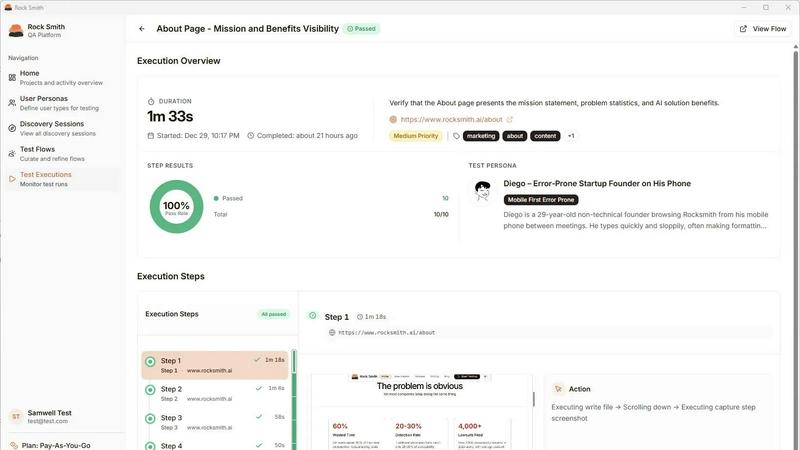
About Rock Smith
Rock Smith is an advanced, AI-powered black box testing platform engineered to automate quality assurance for modern web applications. It fundamentally transforms test automation by deploying autonomous AI agents that visually perceive and interact with applications precisely as a human user would. This innovative approach directly addresses the primary failure point of traditional automation frameworks: the reliance on brittle, code-based selectors like CSS and XPath, which are inherently fragile and break with any UI modification. Instead, Rock Smith utilizes a sophisticated semantic element targeting system, where interface components are identified by their visual characteristics and contextual description, such as "the red 'Delete' icon next to the user profile" or "the primary 'Submit' button at the bottom of the form." This methodology enables tests to be self-healing and drastically reduces the maintenance overhead typically associated with test script upkeep. The platform is specifically designed for fast-moving engineering and QA teams who require reliable, comprehensive, and scalable testing without dedicating excessive developer resources to constant test maintenance. Its core value proposition is delivering intelligent, adaptive, and secure automation that simulates authentic user behavior, uncovers complex edge cases, and provides deep, actionable visibility into application quality, ultimately empowering teams to ship software faster and with significantly greater confidence.
Features
Autonomous AI Testing Agents
Rock Smith employs autonomous AI agents that operate as virtual users. These agents navigate the application by visually parsing the rendered UI, interpreting layouts, colors, text, and interactive elements. They execute test flows by making decisions based on what they "see," mimicking human interaction patterns. This eliminates the need for writing and maintaining low-level code that instructs a bot on how to find an element, as the AI dynamically locates elements based on their semantic and visual context within the current state of the application.
Semantic Element Targeting
The platform's core technology is its semantic targeting engine. Instead of relying on fragile DOM selectors, tests are written using natural language descriptions of UI elements. For example, a test step can instruct the agent to "click the login button on the homepage header." Rock Smith's AI understands this instruction by analyzing the visual interface, searching for elements that match the description in context. This makes test scripts inherently more robust against UI changes, as a redesigned button is still recognized as the "login button," even if its underlying CSS class changes.
Self-Healing Test Automation
Due to its visual and semantic understanding, Rock Smith's test suites possess self-healing capabilities. When a UI change occurs, such as a button moving from the left to the right side of a panel, the AI agent can still identify and interact with it based on its visual attributes and descriptive role. This dramatically reduces test flakiness and maintenance costs. The platform continuously validates and adapts test paths, ensuring regression suites remain functional across iterative development sprints without manual intervention.
Comprehensive Behavior Simulation & Edge Case Discovery
The AI agents are designed to simulate real user behavior, including complex multi-step workflows, data entry, and state transitions. Beyond happy-path testing, the platform intelligently probes for edge cases by varying interaction timing, exploring alternative UI paths, and testing boundary conditions. This uncovers bugs that traditional scripted automation might miss, such as race conditions, layout overflow issues, or unexpected modal interactions, providing deeper quality assurance coverage.
Use Cases
Continuous Regression Testing for Agile Teams
Development teams practicing continuous integration and deployment can integrate Rock Smith into their CI/CD pipelines. The platform automatically executes a full regression suite against every build or pull request. Because tests are maintenance-light and self-healing, teams receive fast, reliable feedback on functional integrity without the bottleneck of constantly updating selector-based scripts, enabling faster release cycles with confidence.
Cross-Browser and Cross-Device Compatibility Testing
Rock Smith can be configured to run the same set of semantic test scenarios across multiple browser types (Chrome, Firefox, Safari, Edge) and viewport sizes (desktop, tablet, mobile). The AI agents interact with the application in each environment, visually verifying that functionality and layout behave correctly. This automates a traditionally manual and time-intensive QA process, ensuring consistent user experience.
Automated User Acceptance Testing (UAT)
QA and product teams can leverage Rock Smith to automate high-level user acceptance tests that validate critical end-to-end user journeys. By scripting tests in plain language (e.g., "Add a product to cart, proceed to checkout, and complete purchase"), stakeholders can ensure core business workflows function as intended after major updates, bridging the gap between technical and non-technical team members.
Legacy Application Test Automation
For applications with complex, dynamically generated, or poorly structured DOMs where traditional selectors are unreliable or impossible to maintain, Rock Smith provides a viable automation path. Its visual interaction model bypasses the underlying code complexity, allowing teams to create stable automated test coverage for legacy systems that were previously only testable through manual effort.
Frequently Asked Questions
How does Rock Smith differ from traditional testing tools like Selenium?
Traditional tools like Selenium rely on programmers writing scripts that use technical locators (e.g., XPath, CSS selectors) tied directly to the application's underlying HTML structure. These break when the UI code changes. Rock Smith uses AI to interact with the visual, rendered interface using semantic descriptions, making tests resilient to code refactoring. It shifts the paradigm from "how to find the element in the code" to "what the user wants to do on the screen."
What is required to start creating tests with Rock Smith?
Getting started requires minimal setup. You typically provide Rock Smith with the URL of your web application. Test scenarios are then created by describing user actions and expected outcomes in a natural, business-readable language or through a recorder that captures your interactions. There is no need to install SDKs into your application codebase or write complex setup scripts, enabling a true black-box testing approach.
Can Rock Smith handle complex, dynamic web applications (SPAs)?
Yes, Rock Smith is specifically engineered for modern, dynamic single-page applications (SPAs) built with frameworks like React, Angular, or Vue.js. Its AI agents wait for and detect page state changes, dynamically loaded content, and asynchronous updates by visually monitoring the UI. This allows it to reliably interact with modals, infinite scroll, real-time updates, and other dynamic behaviors that challenge selector-based tools.
How does the self-healing capability work in practice?
Self-healing is a byproduct of semantic targeting. When a UI element changes, a traditional selector often fails because it points to an attribute that no longer exists. Rock Smith's test instruction, however, remains valid (e.g., "click the Save button"). The AI re-evaluates the screen, identifies the visual component that best matches the description and context of a "Save button," and interacts with it. The test step succeeds without any script modification, effectively "healing" itself.