

Self-Healing Integrations
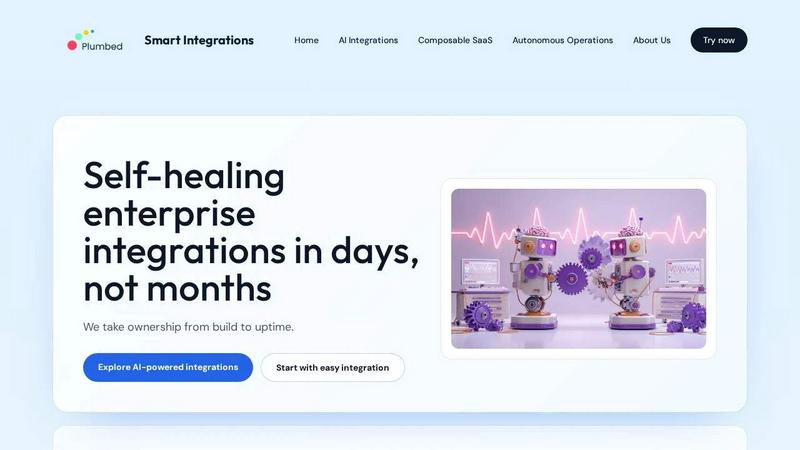
Plumbed.io's self-healing platform automates the full integration lifecycle with AI-driven monitoring and proactive error handling for enterprise.
tool Details
Explore More
Alternatives
About Self-Healing Integrations
Self-Healing Integrations from Plumbed.io is an AI-managed integration platform designed for enterprise environments where custom integrations require ongoing changes, monitoring, and maintenance after go-live. Unlike traditional integration tools that merely build connections between systems, Plumbed.io takes full ownership of the entire integration lifecycle, from initial build to continuous uptime and reliability. The product is specifically engineered for companies that are burdened by the "integration tax" that makes launching new channels, systems, or partners slow and expensive. By replacing custom integration projects with an AI-managed lifecycle, Plumbed.io enables organizations to deploy new connections in days rather than months, while significantly reducing operational overhead. The platform is prompt-driven, production-ready, and self-healing, meaning it automatically monitors integration performance, handles errors proactively, and applies continuous system updates without manual intervention. This product is ideal for enterprises with complex, multi-system architectures that require constant adaptation and maintenance, such as those in finance, healthcare, logistics, and e-commerce. The core value proposition is eliminating the ballooning operational overhead typically associated with legacy integration solutions, allowing businesses to scale efficiently without overloading their engineering teams.
Features
AI-Managed Integration Lifecycle
Plumbed.io automates the entire integration lifecycle, from initial deployment to ongoing maintenance and updates. The AI engine continuously monitors all active integrations for performance anomalies, data synchronization errors, and system compatibility issues. When a potential problem is detected, the system autonomously applies corrective actions, such as re-routing data flows, adjusting API call parameters, or re-authenticating connections, without requiring human intervention. This proactive approach ensures that integrations remain operational and reliable even as underlying systems evolve.
Self-Healing Error Recovery
The platform features an intelligent error recovery system that automatically detects and resolves integration failures in real-time. When a connection drops, a data transformation fails, or a third-party API returns an unexpected error, the self-healing mechanism analyzes the root cause and applies a predefined or AI-generated fix. Common recovery actions include retrying failed transactions with exponential backoff, switching to backup endpoints, reformatting malformed data payloads, and escalating unresolved issues to engineering teams with full diagnostic context. This capability dramatically reduces mean time to resolution (MTTR) for integration incidents.
Prompt-Driven Integration Builder
Integrations are created and modified using a natural language prompt-driven interface, which abstracts away the complexity of traditional API integration coding. Users describe the desired integration behavior in plain language, and the AI translates these prompts into production-ready integration workflows. This approach enables non-technical stakeholders to participate in integration design while ensuring that the resulting connections adhere to enterprise security and compliance standards. The prompt-driven system also supports iterative refinement, allowing users to adjust integration logic on the fly without rewriting code.
Autonomous Operations and Monitoring
Plumbed.io provides comprehensive autonomous operations capabilities that include real-time monitoring dashboards, automated alerting, and predictive maintenance scheduling. The platform tracks key performance indicators such as data throughput, latency, error rates, and system availability across all active integrations. Predictive analytics models identify patterns that precede failures, enabling preemptive corrective actions before end-users are affected. The monitoring system integrates with existing enterprise observability tools and supports custom threshold configuration for mission-critical integrations.
Use Cases
Enterprise CRM and ERP Synchronization
Large organizations often maintain separate CRM and ERP systems that must share customer data, order information, and inventory levels in near real-time. Plumbed.io automates the bidirectional synchronization between platforms like Salesforce and SAP, handling complex data transformations, conflict resolution, and error recovery automatically. The self-healing capabilities ensure that data discrepancies are detected and corrected within seconds, preventing order processing delays and customer service issues. The AI monitors for schema changes in either system and adapts the integration logic accordingly without manual intervention.
Multi-Channel E-commerce Order Management
E-commerce businesses that sell across multiple channels, including their own website, Amazon, eBay, and Shopify, require reliable order ingestion and fulfillment orchestration. Plumbed.io connects each sales channel to a central order management system, handling variations in order formats, shipping requirements, and payment processing. The self-healing integration automatically retries failed order submissions, reconciles inventory counts across channels, and alerts operations teams to fulfillment exceptions. This reduces the operational burden of managing multiple channel-specific integrations and minimizes revenue loss from order processing failures.
Healthcare Data Exchange Between EMR Systems
Healthcare organizations frequently need to exchange patient data between different electronic medical record (EMR) systems, such as Epic and Cerner, while maintaining HIPAA compliance. Plumbed.io provides secure, auditable integration pipelines that handle HL7 and FHIR standard data formats, manage patient identity matching, and ensure data integrity during transmission. The self-healing capabilities automatically detect and resolve data format mismatches, connection timeouts, and authentication failures, which are common in healthcare integration scenarios. The platform also maintains detailed audit logs required for regulatory compliance.
Financial Services Payment and Reconciliation Integration
Financial institutions require highly reliable integrations between payment gateways, core banking systems, and reconciliation platforms. Plumbed.io automates the flow of transaction data, manages retry logic for failed payments, and performs automated reconciliation of settlement reports. The self-healing engine monitors for duplicate transactions, currency conversion errors, and settlement delays, applying corrective actions such as reversing erroneous entries or triggering manual review workflows. This reduces the risk of financial discrepancies and accelerates the month-end closing process.
Pricing
Plumbed.io offers a tiered pricing model based on integration complexity and volume. The Starter plan begins at $2,500 per month and includes up to 5 active integrations, basic monitoring, and email support. The Professional plan is $7,500 per month and supports up to 20 integrations with advanced self-healing capabilities, real-time monitoring dashboards, and priority support. The Enterprise plan is custom-priced and includes unlimited integrations, dedicated AI model training, on-premises deployment options, and 24/7 support with guaranteed SLAs. All plans include the prompt-driven integration builder and automated lifecycle management. Volume discounts are available for organizations deploying more than 50 integrations. A 14-day free trial is available for the Starter plan with no credit card required.
Frequently Asked Questions
How does the self-healing capability actually work in practice?
The self-healing capability operates through a multi-layered detection and response system. First, the AI continuously monitors integration health metrics such as response times, error rates, and data consistency. When an anomaly is detected, the system performs a root cause analysis by examining recent changes to connected systems, API response patterns, and data payload integrity. Based on the identified cause, the platform executes a predefined or AI-generated recovery action, which may include retrying the operation, switching to a backup endpoint, reformatting data, or triggering a full re-synchronization. If the automated recovery fails, the system escalates the issue to engineering teams with complete diagnostic information, including error logs, affected transactions, and suggested remediation steps.
What types of integrations does Plumbed.io support?
Plumbed.io supports a wide range of integration patterns including RESTful APIs, SOAP web services, database connections, file-based data exchange (SFTP, S3), message queues (Kafka, RabbitMQ), and event-driven architectures. The platform works with both cloud-based and on-premises systems, supporting hybrid integration scenarios. Common integrations include CRM to ERP, e-commerce platforms to order management, payment gateways to accounting systems, and healthcare EMR to data warehouses. The prompt-driven builder can accommodate custom data transformation logic, conditional routing, and complex orchestration workflows.
How long does it take to deploy a new integration with Plumbed.io?
Typical deployment timelines for a new integration range from a few days to a couple of weeks, depending on complexity. Simple point-to-point integrations with standard data formats can be deployed in as little as three days using the prompt-driven builder. More complex integrations involving multiple systems, custom data transformations, or regulatory compliance requirements may take up to two weeks. This is a significant reduction compared to traditional custom integration projects, which often require several months of development and testing. The platform accelerates deployment by providing pre-built connectors, reusable integration patterns, and automated testing capabilities.
What happens when a third-party API changes or breaks?
When a third-party API undergoes changes, such as a new version release, deprecated endpoints, or modified authentication requirements, Plumbed.io's self-healing engine detects the incompatibility during routine monitoring. The AI analyzes the API response changes, compares them against expected schemas, and attempts to adapt the integration logic automatically. For example, if an API endpoint is deprecated, the system can switch to a new endpoint or apply URL rewriting. If authentication methods change, the platform can update token generation workflows. If automatic adaptation is not possible, the system alerts the engineering team with specific information about the API change and recommended integration updates.
Similar to Self-Healing Integrations


Memorable Contact
AI-powered relationship memory that helps you remember people, the context behind your connections, and reconnect
screenRIG
Signage and kiosk infrastructure for AI agents. Your agent publishes images, video, streams, web pages and apps to screens via one plugin.screenRIG is

layahost
Moderation, routing, intent and scoring for any text over one Jev-compatible API, hosted in the EU.


Hailuo AI
Create Hailuo AI videos from text or images with guided prompts, motion and camera controls, flexible settings, and downloadable results.
