StockFit API
StockFit API delivers standardized, model-ready SEC financial data with sector-aware metrics for valuation and backtesting.
tool Details
Explore More
Alternatives
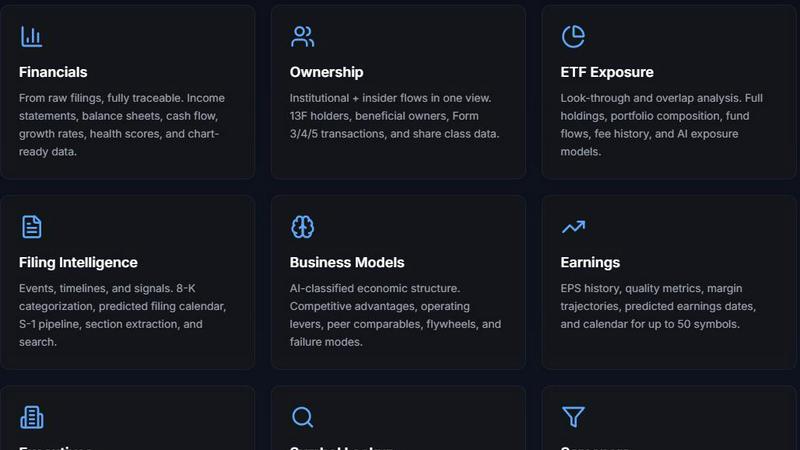
About StockFit API
StockFit API is a financial data platform designed for developers, quants, and research platforms that require direct, high-fidelity access to SEC filing data without the compromises inherent in traditional financial data providers. The core value proposition is eliminating the tradeoff between cheap, inaccurate data tiers and expensive enterprise contracts that strain startup budgets. StockFit API pulls all fundamentals, ownership data, ETF/MF exposure, insider transactions, and filings directly from SEC XBRL filings, with no derived middle layer that can introduce errors or latency. Every data point is traceable back to its original SEC filing, ensuring complete auditability and trust in the numbers. The API handles complex edge cases that other providers often mishandle: amended filings are properly incorporated, non-December fiscal years are computed with correct period alignment, and Q4 financials are reconstructed from the combination of 10-K and 10-Q filings. Beyond standard financials, StockFit API provides rich economic models per company covering offerings, peer comparisons, operating levers, competitive advantages, business flywheels, strategic initiatives, and failure modes. For ETF and mutual fund exposure, the platform delivers detailed models covering mandate, portfolio construction, costs, sensitivities, and use cases, all structured to be AI-friendly for LLM workflows. With over 250 million facts and 5 million filings updated daily, the API offers both a standard REST interface and a native MCP server for integration with Claude, Cursor, and other AI tools, making it a comprehensive solution for financial modeling and backtesting.
Features
Standardized Financials with No Taxonomy Drift
StockFit API delivers financial statements that are standardized across all companies and reporting periods, eliminating the problem of taxonomy drift where different companies or years use different XBRL tags for the same concept. The API normalizes revenue, expenses, net income, balance sheet items, and cash flow components into consistent, model-ready fields. Each financial fact includes its source filing identifier, allowing you to trace any number back to the exact SEC document. The standardization covers income statements, balance sheets, cash flow statements, and comprehensive income, with computed metrics like EBITDA, EBIT, and diluted EPS already calculated. This eliminates the need for your team to manually map or clean financial data before running models.
Amended Filing Handling and Fiscal Year Computation
The API intelligently handles amended SEC filings by incorporating restated data into the correct reporting period, ensuring your models always use the most current and accurate financial information. For companies with non-December fiscal year ends, StockFit API correctly computes fiscal periods and aligns them with the appropriate calendar periods, preventing the misalignment errors common in other data providers. The platform also reconstructs Q4 financials by intelligently combining 10-K annual data with the three preceding 10-Q quarterly filings, providing complete quarterly coverage even when companies do not separately file Q4 reports. This feature is critical for accurate time-series analysis and backtesting.
Economic Models Per Company
Beyond raw financial data, StockFit API provides rich economic models for each company that go far beyond standard financial metrics. These models cover a company's offerings and product lines, peer group comparisons, operating levers that drive profitability, competitive advantages and moats, business flywheels and network effects, strategic initiatives and growth drivers, and potential failure modes and risks. These models are sourced and cited, with each insight traceable back to its origin. The economic models are structured in a machine-readable format that is ideal for LLM workflows, enabling AI agents to reason about company fundamentals, competitive positioning, and investment theses without manual research.
ETF and Mutual Fund Exposure Models
StockFit API provides detailed exposure models for ETFs and mutual funds, covering mandate and investment objective, portfolio construction methodology, cost structure including expense ratios and trading costs, sensitivities to market factors and sector rotations, and use cases for portfolio allocation and risk management. These models are designed to be AI-friendly, allowing LLMs to understand fund holdings, sector exposures, and risk characteristics programmatically. The exposure data is derived directly from SEC filings, ensuring accuracy and timeliness. This feature is particularly valuable for research platforms building portfolio analytics tools, robo-advisors, or any application requiring automated fund analysis.
Use Cases
Quantitative Backtesting and Strategy Development
Quants and algorithmic traders can use StockFit API to build and backtest financial models with high-quality, standardized data directly from SEC filings. The API's accurate fiscal year handling and amended filing incorporation ensure that backtests reflect real-world data conditions, not cleaned or interpolated datasets. The 250 million facts and 5 million filings provide a deep historical record for testing strategies across multiple market cycles. The standardized financials eliminate the need for data cleaning pipelines, allowing quants to focus on model development and signal generation. The sector-aware metrics enable factor-based strategies that compare companies within their appropriate peer groups.
AI-Powered Financial Analysis with LLMs
Developers building AI financial assistants or research tools can leverage StockFit API's native MCP server for seamless integration with Claude, Cursor, and other AI platforms. The economic models and exposure models are specifically structured for LLM consumption, enabling AI agents to answer complex questions about company fundamentals, competitive positioning, and portfolio exposures. The source-cited data allows AI systems to provide transparent, auditable answers with references back to original SEC filings. This use case is ideal for research platforms, investment analysis tools, and educational applications that need to combine AI reasoning with verified financial data.
Portfolio Construction and Risk Management
Wealth management platforms and robo-advisors can use StockFit API's ETF and mutual fund exposure models to build and monitor diversified portfolios. The detailed mandate, portfolio construction, and cost data enable precise asset allocation decisions and risk assessments. The insider transaction data provides early signals of management sentiment and potential corporate events. The ownership data reveals institutional positioning and concentration risks. The API's daily updates ensure that portfolio analytics reflect the most current holdings and exposures, critical for risk management in volatile markets.
Fundamental Research and Valuation Analysis
Research analysts and valuation professionals can use StockFit API to access standardized financials and economic models for thousands of companies. The platform eliminates the manual work of collecting financial data from multiple sources and normalizing it for comparison. The rich economic models provide qualitative insights about competitive advantages, business models, and failure modes that are essential for building investment theses. The source-cited data allows analysts to quickly verify any financial fact by referencing the original SEC filing. This use case is particularly valuable for sell-side research teams, buy-side analysts, and independent research platforms.
Frequently Asked Questions
How does StockFit API ensure data accuracy compared to other financial data providers?
StockFit API pulls data directly from SEC XBRL filings with no derived middle layer that can introduce errors or latency. Every financial fact is traceable back to its original source filing through a unique filing identifier. The platform handles amended filings by incorporating restated data into the correct reporting period, ensuring you always use the most current information. The standardization process normalizes across different XBRL taxonomies without introducing assumptions or interpolations. This direct-from-source approach eliminates the accuracy issues common in cheaper data tiers while avoiding the enterprise contract costs of traditional providers.
What types of data does StockFit API provide beyond basic financial statements?
StockFit API provides a comprehensive set of data types beyond income statements, balance sheets, and cash flow statements. This includes ownership data showing institutional and insider holdings, ETF and mutual fund exposure models with detailed mandate and portfolio construction information, insider transaction records for corporate insiders, and economic models per company covering offerings, peers, operating levers, competitive advantages, flywheels, strategic initiatives, and failure modes. The platform also provides sector-aware metrics and standardized financials that are model-ready for backtesting and valuation analysis.
How does StockFit API handle non-standard fiscal years and Q4 reconstruction?
StockFit API correctly computes fiscal periods for companies with non-December fiscal year ends, aligning them with the appropriate calendar periods to prevent misalignment errors. For Q4 reconstruction, the platform intelligently combines the annual data from a company's 10-K filing with the three preceding 10-Q quarterly filings to produce complete Q4 financials. This is critical because many companies do not separately file Q4 quarterly reports. The API handles all fiscal year configurations automatically, so developers do not need to implement custom logic for different reporting schedules.
Can StockFit API be integrated with AI tools like Claude or Cursor?
Yes, StockFit API provides a native MCP server specifically designed for integration with Claude, Cursor, and other AI tools. The MCP server allows AI agents to directly query financial data, economic models, and exposure models using natural language or structured queries. The economic and exposure models are structured in AI-friendly formats that enable LLMs to reason about company fundamentals, competitive positioning, and portfolio exposures programmatically. This native integration eliminates the need for custom API wrappers or middleware when building AI-powered financial applications.
Similar to StockFit API

Roipad
ROIpad equips SaaS teams with automated positioning intelligence. Find high-converting messaging gaps, track rival moves, and capture market share.
BankStatement2PDF
Convert bank statements to Excel and CSV with 35+ financial tools, transaction extraction, and balance reconciliation features.


Hishab
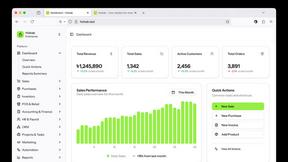
All-in-One POS, Inventory & Accounting Software for Bangladeshi Businesses