

tool Details
Explore More
Alternatives
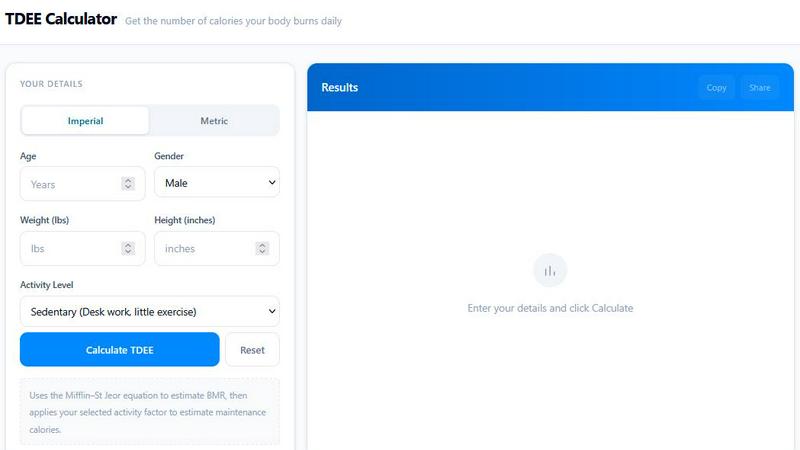
About TDEE Calculator
TDEE Calculator is a precision web-based tool engineered to compute Total Daily Energy Expenditure (TDEE) by applying the Mifflin-St Jeor equation, a scientifically validated formula for estimating Basal Metabolic Rate (BMR). The tool processes user-provided biometric data including age, sex, height, weight, and activity level to generate an accurate estimate of daily calorie burn. Its primary function is to deliver a reliable maintenance calorie baseline, which serves as the foundation for constructing customized nutrition plans for fat loss, muscle gain, or weight maintenance. The calculator is designed for a broad user base ranging from fitness enthusiasts and athletes to individuals seeking structured dietary guidance for health management. Its core value proposition lies in replacing guesswork with data-driven physiology, offering instant, actionable calorie targets that users can refine over time using real-world results. The interface supports both imperial and metric units, ensuring accessibility across global user demographics. By integrating activity-specific multipliers from 1.2 (sedentary) to 1.9 (athlete), the tool accounts for lifestyle variability, making it suitable for desk workers, recreational exercisers, and elite competitors alike. TDEE Calculator is completely free, prioritizing speed, clarity, and practical utility without requiring account creation or subscription. It functions as an educational resource, empowering users to make informed decisions about energy balance, macronutrient distribution, and performance optimization.
Features
Mifflin-St Jeor Equation Integration
The calculator employs the Mifflin-St Jeor equation, a formula validated by research in the American Journal of Clinical Nutrition for its accuracy in estimating resting metabolic rate in healthy adults. For men, the equation calculates BMR as (10 x weight in kg) + (6.25 x height in cm) - (5 x age) + 5. For women, it uses (10 x weight in kg) + (6.25 x height in cm) - (5 x age) - 161. This physiological foundation ensures that the TDEE output is not a generic approximation but a personalized estimate based on core metabolic parameters. The system then multiplies the BMR by a user-selected activity factor to derive the final TDEE, providing a robust baseline for calorie planning.
Activity Level Customization with Defined Multipliers
Users can select from five precisely defined activity levels, each with a corresponding multiplier that adjusts the TDEE calculation to reflect real-world energy expenditure. The levels include Sedentary (1.2) for desk work with minimal movement, Light Exercise (1.375) for gentle activity 1-3 days per week, Moderate Exercise (1.55) for training 3-5 days per week, Heavy Exercise (1.725) for intense training 6-7 days per week, and Athlete (1.9) for twice-daily sessions or highly physical occupations. Each multiplier is scientifically derived to scale the BMR appropriately, enabling the tool to generate accurate maintenance calorie estimates for vastly different lifestyles.
Dual Unit System with Instant Calculation
The interface supports both imperial (pounds and inches) and metric (kilograms and centimeters) measurement systems, allowing users to input their data in the format most familiar to them. Upon entering all required fields and clicking the "Calculate TDEE" button, the system processes the data instantly, applying the appropriate unit conversions internally. This dual-system capability eliminates the need for manual conversion and reduces input errors, ensuring that users worldwide can access accurate results without additional steps. The tool also includes a reset function for quick re-entry of different scenarios.
Results Sharing and Copy Functionality
After calculation, the tool presents the TDEE result alongside practical recommendations for calorie deficit and surplus targets, macro guidance, and activity-based adjustments. Users can copy the results to their clipboard or share them directly via integrated sharing options. This feature facilitates easy documentation for personal tracking, consultation with nutrition coaches, or integration into meal planning apps. The ability to export or share results enhances the tool's utility as a collaborative resource for individuals working with fitness professionals or participating in structured nutrition programs.
Use Cases
Weight Loss Planning with Calorie Deficit Calculation
Individuals aiming to lose body fat can use the TDEE Calculator to determine their maintenance calories and then apply a structured deficit. The tool provides insights into recommended deficit ranges, typically 250-500 calories per day, which corresponds to sustainable fat loss of approximately 0.5-1 pound per week. Users can input their biometric data, receive their TDEE, and subtract the desired deficit to establish a daily calorie target. This approach replaces arbitrary calorie restriction with a physiologically informed strategy, reducing the risk of metabolic adaptation or nutrient deficiencies. The calculator's activity level adjustment ensures that the deficit is appropriate for the user's lifestyle, preventing excessive energy restriction that could impair recovery or training performance.
Muscle Gain Strategy with Calorie Surplus Targets
For users focused on building lean muscle mass, the TDEE Calculator provides the baseline for establishing a controlled calorie surplus. The tool suggests surplus ranges of approximately 200-350 calories per day, which supports muscle protein synthesis and anabolic processes while minimizing fat accumulation. Bodybuilders, strength athletes, and recreational lifters can input their current metrics and activity levels to generate a precise surplus target. The macro guidance feature then helps users allocate these additional calories into protein, carbohydrate, and fat ratios that align with hypertrophy goals. This data-driven approach enables users to optimize nutrient timing and total energy intake for maximal muscle gain with minimal unwanted fat gain.
Maintenance Calorie Tracking for Weight Stability
Individuals who have reached their target weight or who wish to maintain their current physique can use the TDEE Calculator to establish a stable calorie baseline. By inputting their current biometric data and activity level, users receive their estimated maintenance calories. The tool recommends monitoring body weight over a 2-3 week period and adjusting intake by 100-200 calories if weight fluctuates. This use case is particularly valuable for athletes in weight-class sports, individuals recovering from dieting phases, or anyone seeking long-term weight stability without constant dietary monitoring. The calculator's accuracy allows users to confidently plan meals around a known energy requirement.
Performance Optimization for Active Individuals
Endurance athletes, competitive sports participants, and individuals with physically demanding occupations can leverage the TDEE Calculator to align their energy intake with training demands. The activity level multipliers (1.2 through 1.9) account for varying degrees of physical exertion, ensuring that calorie estimates reflect actual energy expenditure. Users can input their specific training frequency and intensity to receive a TDEE that supports recovery, hormonal balance, and performance output. The tool's insights help prevent under-fueling, which can impair recovery and increase injury risk, or over-fueling, which can limit metabolic efficiency. This use case transforms the calculator from a simple weight management tool into a performance optimization resource.
Frequently Asked Questions
What does TDEE mean?
TDEE stands for Total Daily Energy Expenditure, which represents the total number of calories your body burns over a 24-hour period. This includes three primary components: Basal Metabolic Rate (BMR), which is the energy required for essential physiological functions at rest; the thermic effect of food, which is the energy used to digest and process nutrients; and physical activity expenditure, which encompasses both structured exercise and non-exercise activity thermogenesis (NEAT). Understanding your TDEE is fundamental for managing body weight, as it defines the calorie threshold for weight maintenance. Consuming fewer calories than your TDEE creates a deficit that leads to fat loss, while consuming more creates a surplus that supports weight and muscle gain.
How is it different from BMR?
Basal Metabolic Rate (BMR) is a subset of TDEE, representing the minimum number of calories your body needs to sustain basic life functions such as breathing, circulation, and cell production while at complete rest. BMR typically accounts for 60-75% of total daily energy expenditure. TDEE, on the other hand, encompasses BMR plus all additional energy costs, including the thermic effect of food (approximately 10% of total calories) and all forms of physical activity. While BMR is measured under strict laboratory conditions, TDEE is a practical, real-world estimate that accounts for your specific lifestyle and activity patterns. The TDEE Calculator first estimates your BMR using the Mifflin-St Jeor equation, then multiplies it by an activity factor to arrive at your total daily energy needs.
How many calories should I eat to lose weight?
For sustainable fat loss, a daily calorie deficit of 250-500 calories below your TDEE is generally recommended. This deficit typically results in a weight loss rate of 0.5-1 pound per week, which is considered safe and maintainable. To determine your specific target, first use the TDEE Calculator to find your maintenance calories, then subtract the desired deficit. For example, if your TDEE is 2,500 calories, a 500-calorie deficit would set your daily intake at 2,000 calories. It is important to note that deficits larger than 500 calories may lead to muscle loss, metabolic slowdown, and nutrient deficiencies. The calculator provides practical deficit recommendations based on your individual data, ensuring your weight loss plan is both effective and physiologically sound.
How accurate is this calculator?
The TDEE Calculator provides an estimate based on the Mifflin-St Jeor equation, which research has shown to be one of the most accurate formulas for predicting resting metabolic rate in healthy adults, with an error margin of approximately 10% for most individuals. However, the final TDEE also depends on the accuracy of your self-reported activity level, which is inherently subjective. For best results, treat the calculator's output as a starting estimate and monitor your body weight over 2-3 weeks. If your weight remains stable, the estimate is likely accurate. If you experience ongoing weight gain or loss, adjust your calorie intake by 100-200 calories and reassess. The tool is designed for educational purposes and should not replace personalized medical or nutrition advice from a licensed healthcare professional.
Similar to TDEE Calculator



Caesura
Caesura is a macOS menu-bar app that reminds you to drink water, stretch, rest your eyes, and breathe on science-backed intervals.

PrettyScale
PrettyScale analyzes 468 facial landmarks entirely in-browser to score attractiveness, detect face shape, find celebrity look-alikes, and estimate.

Holly AI
Holly AI automates patient scheduling and front desk tasks by integrating with your EHR, CRM, and payment systems to reduce manual work and boost.

Stop Smoking App
The Stop Smoking App helps you quit cigarettes and vaping by tracking progress, managing cravings, and providing daily motivation for success.

Droidal Insurance Verification AI Agent
Droidal Insurance Verification AI Agent ensures real-time, accurate eligibility checks to minimize denials and streamline patient care processes.

MedicalRide.Org
Book private non-emergency medical rides in five minutes with MedicalRide.org for appointments, discharges, and more, ensuring tailored.