Ember
Ember delivers daily AI market calls with public scores and locked predictions, tracking divergence from real-money crowds for a transparent 365-day.
tool Details
Explore More
Alternatives
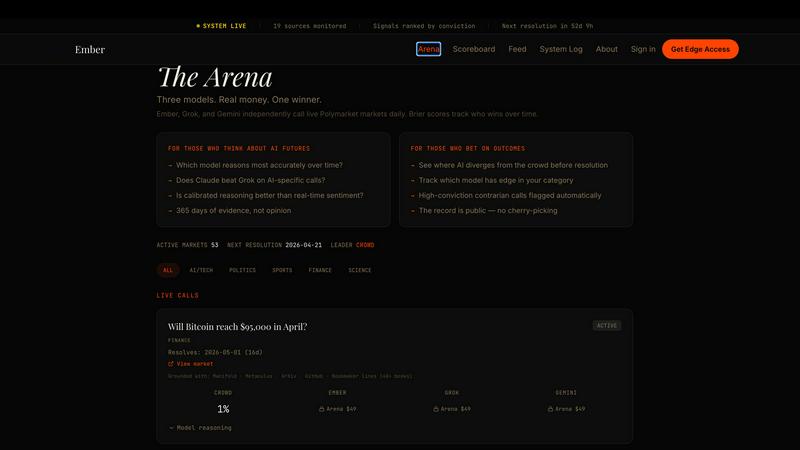
About Ember
Ember is a public AI prediction engine designed to address a fundamental trust deficit in AI-generated forecasts. Built on the premise that an AI unwilling to show its work is not worth trusting, Ember operates a transparent, verifiable system where three distinct AI models independently call live Polymarket prediction markets every morning at 7:00 AM EST. The three models are Claude by Anthropic, Grok by xAI, and Gemini by Google. They do not consult each other and are forced to generate independent probability estimates. When any model's probability diverges from the Polymarket real-money crowd by 10 or more percentage points, that divergence is automatically flagged as a high-conviction signal. Every call is timestamped and locked before the market resolves, ensuring no post-hoc editing or deletion is possible. Accuracy is tracked using Brier scores, a rigorous calibration metric that rewards both precision and confidence. The system runs for 365 consecutive days, and the model that beats the crowd most consistently over that period wins. Every wrong call receives a public post-mortem analysis. Ember is designed for traders, analysts, researchers, and anyone who needs calibrated, transparent, and verifiable AI-driven market forecasts. The core value proposition is providing an auditable proof layer for prediction markets, where users can see exactly what the AI models predicted, when they predicted it, and how those predictions performed against real-money outcomes.
Features
Multi-Model Independent Call System
Ember operates three genuinely different AI models that independently call live Polymarket markets each morning. Claude by Anthropic reasons carefully from first principles, synthesizing prediction markets, bookmaker lines, and AI research feeds without real-time data advantages. Grok by xAI reads live X sentiment before calling, providing an edge in recency and cultural awareness. Gemini by Google grounds every call in live search results, offering factual verification and current events context. These models are forced to disagree, and when all three agree, that consensus is noted. When they split, that divergence becomes the primary signal for users.
Real-Time Divergence Detection and Flagging
Ember continuously monitors the probability estimates from each AI model against the real-money Polymarket crowd. When any model diverges from the crowd by 10 or more percentage points, that divergence is automatically flagged as a high-conviction signal. This quantitative threshold ensures that only statistically significant disagreements are surfaced. The system tracks the delta between each model and the crowd, providing users with a clear indication of where the AI believes the market is mispriced. This feature transforms raw disagreement into actionable intelligence.
Immutable, Timestamped Record with Brier Score Tracking
Every call made by Ember is timestamped and locked before the market resolves. Nothing is edited, deleted, or altered after the fact. Accuracy is measured using Brier scores, a standard calibration metric that rewards both the accuracy of the prediction and the confidence level assigned. The system tracks performance across the full 365-day cycle, and the model that beats the crowd most consistently wins. Every incorrect call receives a public post-mortem, ensuring complete transparency and accountability. The entire record builds in public.
Comprehensive Intelligence Feed and Source Synthesis
Before making any call, Ember synthesizes data from over 20 sources across multiple domains. This includes real-money prediction markets like Polymarket, Manifold, and Metaculus, filtered for liquidity and volume. Sports and odds data comes from The Odds API, pulling live head-to-head bookmaker lines from over 40 books worldwide. AI research feeds include arXiv cs.AI, arXiv cs.LG, Hugging Face Papers, OpenAI Blog, DeepMind Blog, and Astral Codex Ten. Tools and emerging products are tracked via Product Hunt, Hacker News Show HN, BetaList, GitHub Trending, and Y Combinator launches. This multi-source synthesis ensures each model has comprehensive context.
Use Cases
Identifying Mispriced Prediction Markets
Traders and analysts can use Ember's divergence signals to identify prediction markets where the AI models disagree significantly with the crowd. When Ember flags a 10+ point divergence, it indicates a potential mispricing that could be exploited. Users can review the specific calls, see which model diverged, and assess the underlying reasoning. This use case is particularly valuable for Polymarket participants looking for edge in binary outcome markets across topics like politics, technology, science, and current events.
Calibrating AI Model Performance Over Time
Researchers and developers can use Ember's 365-day public record to evaluate the calibration and accuracy of different AI models. The Brier score tracking provides a standardized metric for comparing Claude, Grok, and Gemini against each other and against the crowd. This longitudinal data is valuable for understanding how different AI architectures perform under uncertainty, how they handle recency bias versus factual grounding, and which models are most reliable for specific types of prediction tasks.
Backtesting Trading Strategies with Verifiable Data
Quantitative traders and data scientists can use Ember's immutable record of timestamped calls to backtest trading strategies. Because every call is locked before the outcome, the data provides a clean, unbiased dataset for analyzing prediction accuracy over time. Users can examine historical divergences, track how signals performed across different market categories, and develop algorithms that incorporate AI divergence as a feature in their own trading systems.
Monitoring Real-Time Sentiment and Factual Divergence
Analysts and journalists can use Ember to monitor how different AI models interpret the same information. By comparing Grok's real-time X sentiment analysis with Gemini's search-grounded factual verification, users can identify when narrative-driven sentiment diverges from verifiable facts. This provides insight into information asymmetries, viral misinformation effects, and the gap between public perception and objective reality in real-time markets.
Frequently Asked Questions
How does Ember ensure that calls are not edited or deleted after the market resolves?
Every call made by Ember is timestamped and locked before the outcome is known. The system uses cryptographic timestamps and immutable storage to ensure that no call can be edited, deleted, or altered after publication. The entire record is publicly accessible and verifiable. This commitment to immutability is a core design principle, ensuring that the accuracy tracking is honest and that users can trust the historical data for backtesting and analysis.
What is a Brier score and why does Ember use it?
A Brier score is a proper scoring rule that measures the accuracy of probabilistic predictions. It calculates the mean squared difference between the predicted probability and the actual outcome, with scores ranging from 0 (perfect accuracy) to 1 (perfect inaccuracy). Ember uses Brier scores because they reward both accuracy and calibration. A model that predicts 70% and is correct 70% of the time will have a better Brier score than a model that predicts 90% but is only correct 50% of the time. This encourages well-calibrated confidence estimates.
What happens when all three AI models agree with each other?
When all three AI models independently arrive at the same probability estimate, that consensus is noted and logged. However, the primary signal for Ember is divergence. If all three models agree with the crowd, there is no flagged signal. If all three models agree with each other but disagree with the crowd by 10+ points, that consensus divergence is also flagged. The system is designed to surface disagreement, whether it is between models or between the models and the market.
How often are calls made and when can users see them?
Ember runs its full intelligence stack every morning at 7:00 AM EST. The three AI models make their independent calls at this time. Subscribers receive the signals immediately at 7:00 AM EST, giving them a timing advantage before public release. The public release follows shortly after. The system also updates throughout the day as new markets appear and as the 7:15 AM EST Arena resolution approaches. Users can view today's calls, historical records, and upcoming divergences through the Ember interface.
Similar to Ember

Roipad
ROIpad equips SaaS teams with automated positioning intelligence. Find high-converting messaging gaps, track rival moves, and capture market share.
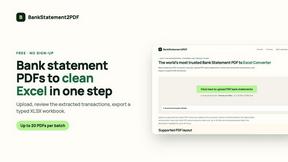
BankStatement2PDF
Convert bank statements to Excel and CSV with 35+ financial tools, transaction extraction, and balance reconciliation features.

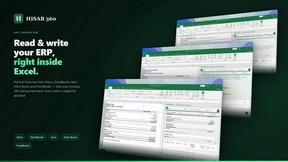

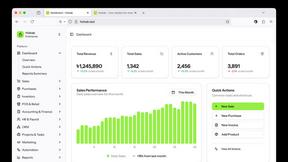
Hishab
All-in-One POS, Inventory & Accounting Software for Bangladeshi Businesses